
The UK's AI Planning Story Is Real — Just Not the AI Part
The measurable speedups in Britain's building-permit AI push come from structured data and rule-based checks. The generative model is still a prototype with an open accountability question.
The UK’s AI Planning Story Is Real — Just Not the AI Part
Two tools, one headline, and most of the coverage is wrong
UK coverage keeps lumping two very different things under one banner: “AI halves planning approvals.” It doesn’t. Not yet. And the real story — what actually shipped — is better than the headline.
There are two tools. Extract is live — built by MHCLG’s Incubator for AI on Google DeepMind’s Gemini, rolled out to every council in England in spring 2026. It reads decades-old planning PDFs, scanned maps, even scribbled margins, and turns them into structured, georeferenced data. That’s the job. No decisions.
Augmented Planning Decisions (APD) is the other one — the one everyone quotes. DeepMind, Google Cloud and Faculty are prototyping it to triage householder applications, cite policy, summarise objections and draft a first assessment. APD is alpha. Three councils. No published accuracy numbers. National rollout from 2027, if it works.
Mix those up and you misread the whole program. Don’t.
The “50% faster” number is a goal, not a result
Every article repeats “cutting decision times from eight weeks to four.” It’s a stated goal, not a measured outcome. APD is running as an alpha at Barnet, Camden and Dorset. There’s no published accuracy rate, no error rate, no officer-override rate, no independent audit.
The government’s own wording is careful: aims to, is expected to, if successful. The press turned that into a done deal. It isn’t.
The other famous number — “255 hours saved per council per year” from Extract — is also a projection. It’s extrapolated from trials across 20 councils, and MHCLG notes there’s “still a lot of work ahead to make Extract production ready.” Despite being available to every council in England, only around 50 were actively using it by mid-2026.
None of this makes the program fake. It means you should call it direction of travel, not settled fact. If you’re building on this, that difference is the whole game.
The fastest measured number isn’t the AI

Here’s the part that should stop you mid-scroll.
The only real, measured end-to-end speedup in the UK planning program — a Lawful Development Certificate processed in about 30 minutes instead of an hour-plus on legacy software — didn’t come from a generative model. It came from PlanX and BOPS, which use human-authored flowchart rules. Deterministic and auditable. Boring on purpose.
The fastest number on the table is rule-based and accountable, not a language model.
If you build vertical AI for regulated work — planning, healthcare, finance, aviation — you know the trade: defensible beats dazzling. A rule you can point to in a judicial review beats a model output you have to justify.
If you’re pitching an “autonomous planning AI” and your quickest competitor is a flowchart, the flowchart wins on what a council actually needs: speed and an audit trail.
Extract’s real win is narrow, concrete, and about data — not intelligence
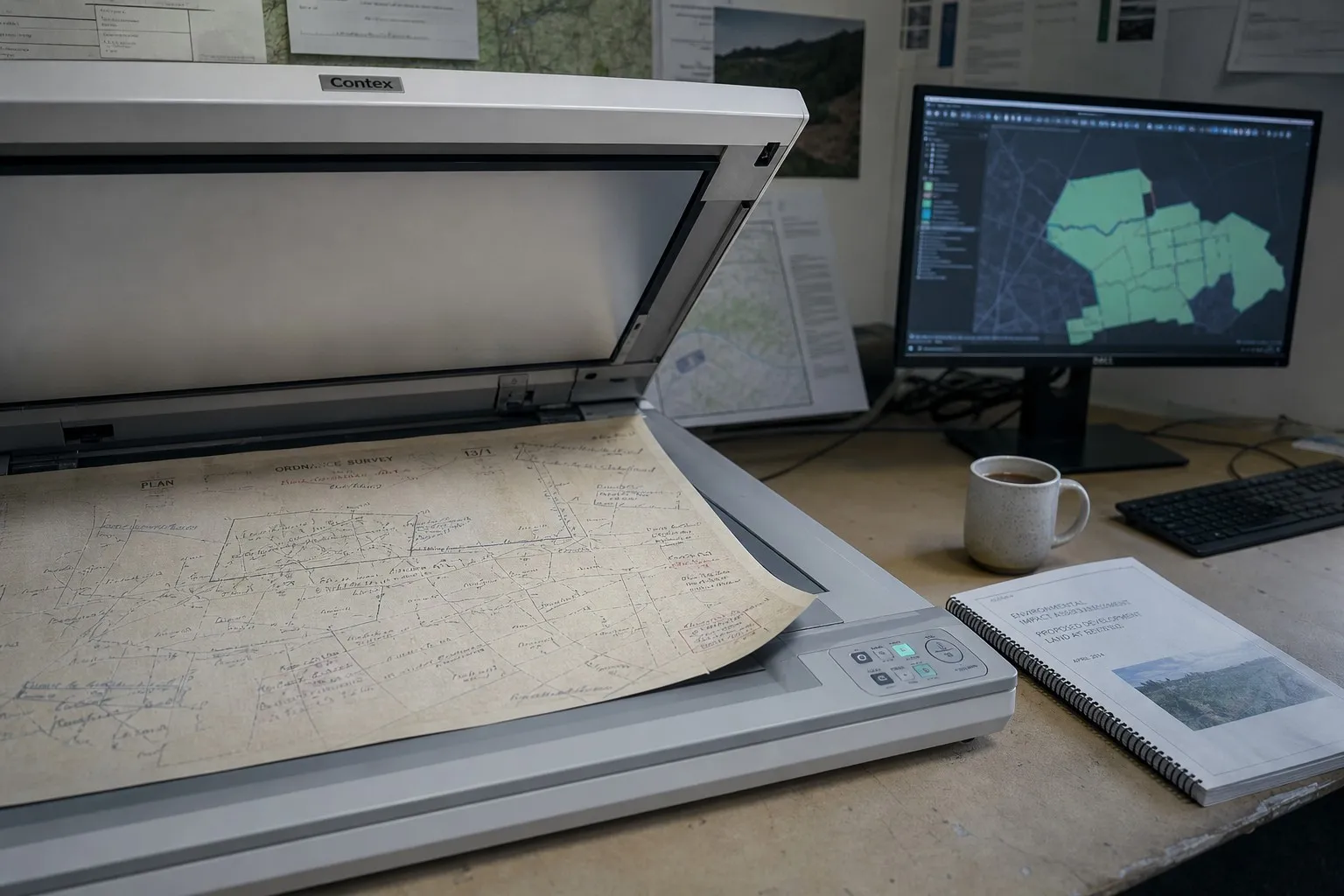
A digitisation task that used to take a trained planning officer 1–2 hours now runs in under 3 minutes for about 10p per document. Roughly 100% text-field extraction. 94% date accuracy. 90% of traced site boundaries hitting 0.8 IoU against the ground truth.
The pipeline is unglamorous and instructive: an LLM pulls text from scanned PDFs; vision models with OpenCV and Meta’s SAM trace map boundaries into polygons; the polygons get georeferenced to Ordnance Survey coordinates. The output isn’t a decision. It’s queryable structured data — the kind a council back-office system, or the national Planning Data Platform, can ingest without a human re-keying it.
That’s the shape of the real value. Not “AI reviews your application.” Not “AI decides.” Just: the domain’s documents are now data.
Once that’s true, downstream work — validation, constraint checking, policy cross-reference, eventually assessment drafting — opens up. And the model that does it becomes swappable. Gemini today, something else in two years. The queryable data layer you built keeps its value.
This is the pattern to internalise. Notion didn’t win because it had the best text editor — it won because it made unstructured work queryable. Stripe didn’t win because its ML models were smarter — it won because it turned payments into structured, addressable objects. Extract is doing the same thing to a hundred years of paper planning records.
The planners are politely raising the question nobody has answered

The Royal Town Planning Institute — the planners’ own body — put out guidance that reads like a very well‑mannered warning shot. They welcome AI for admin and evidence bases. They also name, in order: inaccurate outputs from old scans, accountability, copyright and security risks. They say “AI is not neutral.” They flag the deskilling of junior planners who never learn to read the raw material. And they point out that scaling one national model across every council makes any single flaw systemic.
APD’s design is the tell. Officers must verify every AI‑provided policy citation. “People remain the final decision makers.” That’s the right posture — and also an admission that nobody has answered the real question: who is liable when an AI‑influenced decision is later challenged in court?
That question is the filter every vertical‑AI builder should run their own product through. If a vendor pitches you “autonomous” anything in a regulated workflow and can’t show an audit trail — citations, source documents, a reasoning path a human can verify — they haven’t built a deployable tool. They’ve built a demo.
What to do on your desk Monday
If you submit planning applications or build tools for people who do, ignore 2027 for now.
Focus on Open Digital Planning. PlanX on the applicant side captures structured, constraint‑aware answers instead of accepting a flat PDF. BOPS on the council side validates data‑rich submissions automatically. PlanX is in production at 16 English councils with 23 more funded. Submitting queryable structured data instead of a flat drawing PDF is what already clears validation faster today — independent of any AI.
So two moves for anyone shipping into this workflow:
One — make your submissions machine‑readable now. Clean structured metadata. Consistent drawing conventions. Fields the council’s systems can ingest without a human re‑keying them. This isn’t prep for the future. It’s how you hit the fast validation path that exists this week.
Two — own your domain’s data layer; don’t wait for someone else’s model. The durable edge in Extract, in Singapore’s CORENET X, in Australia’s Archistar, is the same shape: whoever turns the domain’s documents into structured, checkable data owns the workflow. The model on top is commodity. It will get cheaper, better, and interchangeable. The structured data you built stays yours.
If you take one thing from the UK program, take this: the flashy generative demo made the headlines, but the measurable speedups came from structured data and accountable rules. That’s not a bug in the story. That’s the story.
The builders who win the next wave of vertical AI won’t be the ones with the best prompts. They’ll be the ones who, five years ago, started turning their domain’s paper into data.
Start this week. Pick one document type in your workflow — a submission, a spec sheet, a compliance form — and make it structured. That’s the move.